

What is a Modular Kitchen? — A Complete Guide for Bangkok Buyers
What modular kitchen actually means — and what it doesn't
The term "modular kitchen" describes a system in which every cabinet, drawer unit, tall unit, and open shelf is factory-manufactured to standardised dimensions — modules — that combine to fill a kitchen space precisely. The critical distinction is that the manufacturing happens in a controlled factory environment, not on-site. This is not the same as a flat-pack self-assembly product, and it is not the same as traditional site-built joinery. Understanding the difference is the first decision a Bangkok buyer needs to make.
*Site-built kitchens* are constructed in your home by a carpenter or joinery team. Quality is entirely dependent on the skill and materials discipline of the individual craftsperson. In Bangkok's renovation market, this variability is significant. Site-built kitchens are also difficult to modify later and typically use materials that have not been independently certified for emissions or structural performance.
*Flat-pack modular systems* are factory-made but designed for simple, low-cost self-assembly. They use materials at the economy-to-mid tier, with hardware engineered for basic use. They are appropriate for short-term occupancy or budget-constrained projects. They are not a long-term investment.
*Premium modular systems* — the category that includes STOSA CUCINE — are factory-engineered to the same precision tolerances used in European automotive and aerospace manufacturing. Every component is produced under quality management systems, certified for materials and emissions, and built with professional-grade hardware rated for 100,000+ operational cycles. Installation is carried out by trained technicians, not general contractors.
Why modular kitchens suit Bangkok's residential market specifically
Bangkok's condominium market spans an enormous range of floor plan configurations — from 5-square-metre galley kitchens in studio units to 25-square-metre open-plan cooking spaces in penthouses. The modular system's fundamental advantage is that it adapts to all of them with equal precision. Because every unit is manufactured to exact dimensions, the final installation has no dead corners, no filler panels disguising miscalculated spacing, and no visible inconsistencies between adjacent units.
The factory quality control argument is particularly relevant in Bangkok, where site-built joinery quality varies enormously between contractors. Premium modular kitchens arrive at your home having already passed dimensional checks, surface finish inspections, and hardware function tests at the factory. The installation team assembles and fits; they do not fabricate. This eliminates the most common source of kitchen renovation disappointment: the gap between what was specified and what was actually built.
Installation time is a meaningful consideration for Bangkok condominium owners. A full STOSA CUCINE modular kitchen installation typically takes two to four days. Equivalent site-built joinery in the same space frequently takes four to six weeks, with the associated dust, noise, and disruption to neighbouring units.
What separates premium modular from standard modular
Three criteria define the difference in practice.
Board certification is the most important and least-discussed. CARB P2 (California Air Resources Board Phase 2) certification sets strict limits on formaldehyde emissions from the composite wood panels used in cabinet carcasses. Uncertified composite wood — common in lower-cost modular systems — can emit formaldehyde at levels that affect indoor air quality. In a Bangkok condominium where air conditioning circulates indoor air continuously, this matters. Every STOSA CUCINE cabinet meets CARB P2 as standard.
Hardware specification determines how long the kitchen actually functions at the level it was installed. Premium systems specify Blum, Hettich, or equivalent hardware rated for 100,000+ open-close cycles. Standard systems use unrated equivalents that begin to fail within two to three years of daily use. In a kitchen used twice daily, 100,000 cycles represents approximately 137 years of operation. Generic hardware at the same frequency may show problems within three.
Dimensional precision determines how the finished installation looks. Factory tolerances at the STOSA CUCINE manufacturing level are within 0.1mm per unit. This means adjacent door faces align perfectly, drawer fronts sit in consistent planes, and gap widths between units are uniform. This is the difference that is immediately visible to anyone who has seen both a premium and a standard modular installation side by side.
STOSA CUCINE's modular system in Thailand
STOSA CUCINE is manufactured in Pesaro, Italy, and is the only Italian-certified modular kitchen brand with dedicated showrooms in both Bangkok and Phuket. Every product in the range carries CQP (COSMOB Qualitas Praemium) certification — the highest independent quality standard in the Italian furniture industry — alongside FSC® chain-of-custody and CARB P2 compliance. The collection spans Contemporary, Transitional, and Classic style families, with design consultants available at both showroom locations to work through complimentary 3D layouts and detailed quotations.
STORE LOCATOR
Stosa cucine stores offer a valuable shopping experience.
From a project defined in every detail to an environment to be experienced in your own home
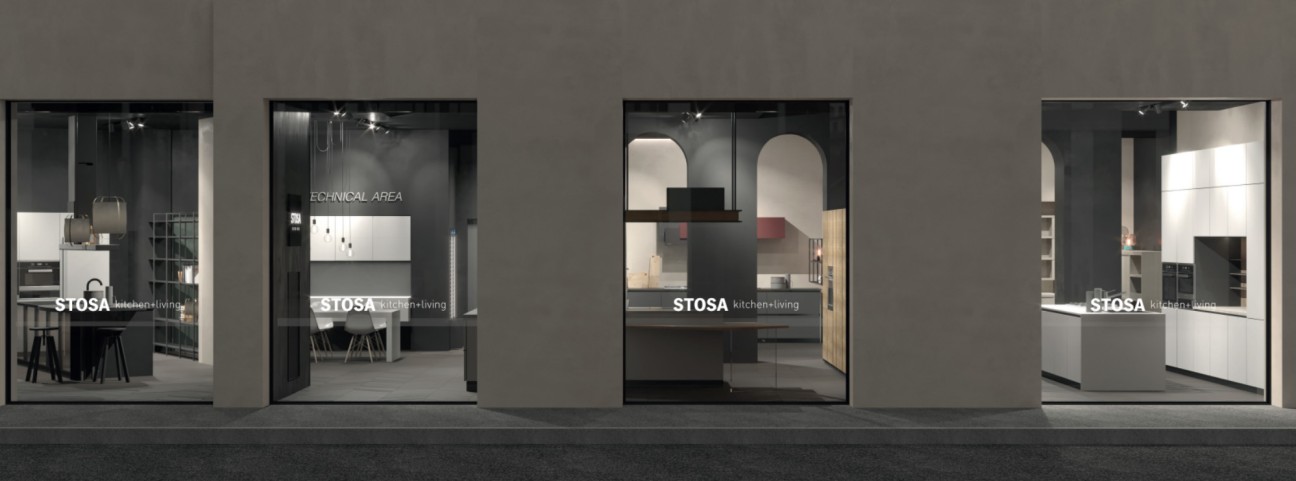
Crystal design center (cdc), building f, 1st floor 888 praditmanutham rd, khlong chan, bangkapi district, bangkok, thailand 10240